Does this mean we are responsible for what we read in the news? If this is the case - does this mean we are letting terror take hold?
Tuesday, 30 September 2014
Are We Letting Terror Take Hold?
Greg Curtain in his article entitled Media, not the judicial system, to blame for soft-on-crime view quotes George Orwell reflecting on how "murders reported in the mass media had certain dramatic and tragic qualities that made them memorable and newsworthy". In this way it's not surprising that various studies such as that by the Australian Psychological Society and the Australian Institute of Criminology report that while official crime statistics show most crimes are non-violent, media reports often suggest the opposite and sensationalise the truth. While it may be no surprise that things in the media are not really as bad as they seem, an article written recently commemorating the 09 September 2004 bombing of the Australian embassy in Jakarta reminds us not of the threat of terrorism we are told is imminent, but that it is important to take a reality check, and to seek effective and meaningful courses of action against the root causes of our fears.
As a supply and demand industry, perhaps the media is not to blame for the atmosphere of fear - the constant terror, violence and crime updates on the news. Maybe we want to hear stories of intractable conflict, of martyrs and victims - surely it only sells because we buy it?
Does this mean we are responsible for what we read in the news? If this is the case - does this mean we are letting terror take hold?
Wednesday, 21 May 2014
Rethinking Australia’s Indonesia Policy to Build Real Relations
"INDONESIA looms as the most important strategic reality in Australian defence thinking. We forget that fact when relations between Canberra and Jakarta are broadly positive."
Peter Jennings (2013)
Prime Minister Abbott has announced his intent to focus on the development of strong economic and business relations with Indonesia as a consequence of believing Australia has historically underinvested in building and maintaining close ties. Calls for strong business, economic and defence links will only scrape the surface of relationship issues between Australia and Indonesia; what is needed is a deep and honest ambition to understand one another as neighbours and not just work-mates. Such an understanding needs to be garnered at a levels across the socio-political spectrum so that Australians and the broader international community alike have access to the ground truth of the environment breaching language, cultural and religious barriers to address the underlying issues, rather than focusing on the tip of the iceberg at the policy level. A deeper understanding of Indonesian society and its issues is critical because these factors make up the rest of the iceberg that inevitably sinks the ship of harmonious inter-governmental interaction.
- Jennings, P., (2013), "Why we need deeper ties with Indonesia", The Australian, accessed online on 16 May 14 at http://www.theaustralian.com.au/national-affairs/opinion/why-we-need-deeper-ties-with-indonesia/story-e6frgd0x-1226730270637#
Thursday, 31 January 2013
Dr. Seuss on Conflict Resolution
In the popular satire, the “Star-bellied Sneeches”,
Dr. Seuss illustrates his opposition to social and cultural discrimination –
more specifically his disdain for anti-Semitism - by creating two cohabitating
races of “Sneeches”; one with stars on their bellies and one without. Those
with star bellies discriminate against those without until one day when an
entrepreneur named Sylvester
McMonkey McBean offers the starless Sneeches the chance to have stars tattooed
on their bellies for a price. All the Sneeches formerly without star-bellies
get tattooed to the disapproval of the original Star-bellied Sneeches who
proceed to have their stars removed by McBean for a higher price than it cost
the other Sneeches to get the original star tattoo, in the belief they can
maintain their special status by being different to the newly star-bellied
Sneeches. This process of starring and de-starring continues and escalates:
“until neither the Plain nor the Star-Bellies knew
whether this one was that one... or that one was this one
or which one was what one... or what one was who.”
All Sneeches are broke and their identity is
confused but the futility of their transformations is not lost on them as they
learn that no Sneech is better for having stars or not having stars and all
live happily ever after. The end.
In the real world, Sneeches are people experiencing ethnic
discrimination and McBean is anything ranging from economic hardship, natural
disaster, political under-representation misrepresentation, foreign
intervention/invasion or poverty. What makes a happy ending so easy (apart from
the fact that the “Star-bellied Sneeches” is fictional) is that McBean left and
the two conflicting parties had the clarity of mind and ability to see the
futility of their hatred campaign and the need to cooperate to have a future.
Very rarely in modern ethnic conflict does McBean just up and leave, in fact he
often continues to hang around and exponentially fuel the ethnic division and
work to deepen pre-existing divisions. The global audience, as witnesses to ethnic
violence, need to develop methods of preventing McBean from entering a
community of Sneeches and when it is too late for this, they must focus on finding
a way to make him leave.
Monday, 17 December 2012
How institutionalising and categorising narrows the way we think
In his 2011 paper "Institutional Rigidity and Evolutionary Theory: Trapped on a Local Maximum", Dr Ian S. Lustik describes how institutions impact on individual and group behaviour because of the way they affect thought processes and inspire attachments. Lustik comments that "limits to effectiveness, pace of institutional change and reasons for resistance to change are not fully understood" and in response to this he addresses these issues using evolutionary theory.
"In any case, this notion - that "history is efficient" - is certainly not an implication of evolutionary theory, not in the natural world and not in the social world either. Indeed it is the very effectiveness of evolutionary theory in accounting for suboptimality that offers political scientists and social scientists more generally, an approach to explaining the prevalence, not only of institutional suboptimality, but to the combination of adaptation and extreme resistance to change that institutions display."
Lustik is essentially describing how evolutionary theory accounts for the inefficiencies it is heralded as capable of ridding. The implications of this in political science theory is when group memory is used to implement improvement and progress the group, it is likely to do so in reaction to past experience, which can only foresee short-term future obstacles. Lustik draws comparison here between Gaullist France and Israel, where revolution in the former created a better, more suitable form of government to supersede one that had evolved to perform well in its institutions but could not withstand the driving effects of change elsewhere. In the latter, however, it still waits to be seen if a revolutionary force strong enough can drive change in a state whose government is so comfortable in its political institutions and dependant on deeply embedded arrangements with "small religious and highly ideological right-wing groups that prevent any realistic peace plan from being put forward."
In light of the recent elections it is interesting that America faces similar evolutionary problems in that:
"In the United States, the Madisonian system described in Federalist 10, that prevents tyranny by dividing and balancing power among states, Houses of Congress, and branches of the Federal government, has also institutionalized a kind of gridlock in so many domains that the confidence of the American people in its government is falling to record lows. Just as Washington may well be understood as stuck on a local maximum—fit enough to allow incumbents to be re-elected, but not fit enough to solve the problems posed to it in the twenty-first century while enabling re-election–so may we understand the predicament of the Republican Party in this election cycle. As has been widely observed, any candidate wishing to win the Republican nomination may be forced to position himself or herself in such a way as to attract Tea Party support; thereby greatly complicating if not rendering impossible the rapid adaptation that will be necessary to achieve a position on the rugged ‘electability’ fitness landscape near the position that wins by attracting dependents and conservative Democrats."
Blogger/political scientist Jay Ulfelder comments on this article:
"Political regime types are the species of comparative politics. They are “analytic categories invented by observers to correspond with stabilized patterns of exhibited characteristics.” In short, they are institutionalized ways of thinking about political institutions. The patterns they describe may be real, but they are not essential. They’re not the natural contours of the moon’s surface; they’re the faces we sometimes see in them."
He also refers to Mary Goodden's 2010 picture titled "Video Game Taxonomy" from her website Well-Rendered.com, which was initially created jokingly, but actually has some relevance to how we categorise the way we think in an attempt to provide inter-connectedness and meaning.
The development of groups as evolutionary entities can certainly be useful in terms of providing an answer to symptoms of social breakdown and conflict, but only so long as we are careful it does not become another category with which to cauterise free and progressive thinking on the subject.
Saturday, 8 December 2012
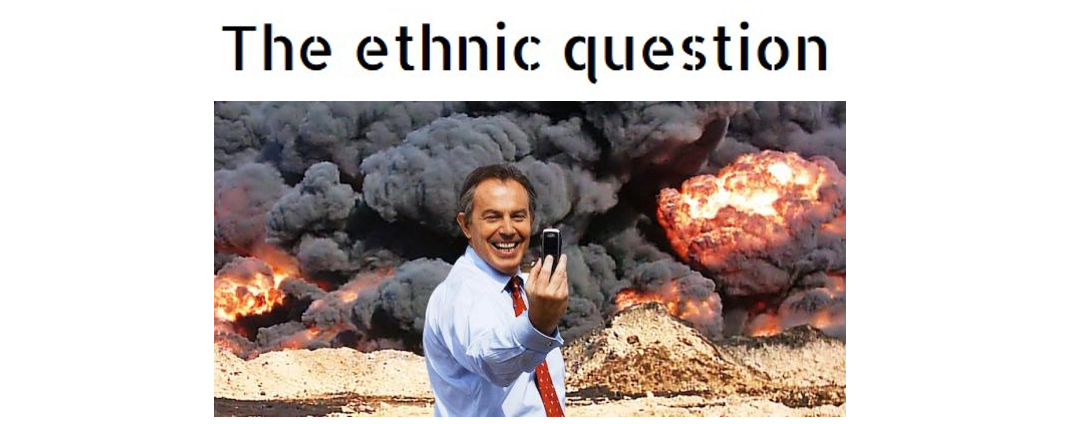
Pakistan- a nation built on ethnic boundaries?
Ethnic Groups in Pakistan: Pakistan was born divided by culture, ethnicity, language and territory. The one uniting force - language - fails to truly unite Pakistan, as English - the official means of communication - is only spoken by 10.97% of the people. Urdu, a mixture of Punjabi, Arabic, Farsi and English (amongst others) was designed as a common language but is spoken by less people than English.
The issue of insular ethnic communities and education are two of the biggest problems that need to be addressed in order to unite Pakistan as a nation that can face the myriad of problems on its doorstep. What currently divides Pakistan can be transformed in to a rich Pakistani culture that incorporates acceptance and communication in order to progress.
Are Isreael's E1 settlement plans likely to bring about settlement?
Despite international protests, Israel looks set to go ahead with its plan to create 3,000 settler homes in the West Bank. Considered an illegal move by a number of nations, there is fear that Israeli housing could bisect the West Bank and cut off Palestinians from Jerusalem, further dimming hopes for a contiguous state.
So what does Israel hope to achieve by doing this?
And what did Palestine think would happen once it became a non-member observer state in the UN?
Egyptian opposition shuns Morsi's call for dialogue
With no foreseeable plan to rescind his self-serving decree of wide constitutional powers, it does not seem likely Morsi will delay the vote set for December 15 on a constitution drafted by an Islamist-led assembly said to fail to meet the aspirations of all Egyptians. Mursi's planned dialogue meeting was expected to go ahead Saturday, despite the fact most opposition factions would be absent.
Token gestures to appease the international community will not resolve the conflict in Egypt and rid a failing state of a dictator.
Where does the international community draw the line and
take action to stop the bloodshed?
Subscribe to:
Posts (Atom)
